GHK-Cu collagen studies
The culture dish, the topical comparison and the less tidy business of remodelling.
The fibroblast experiment
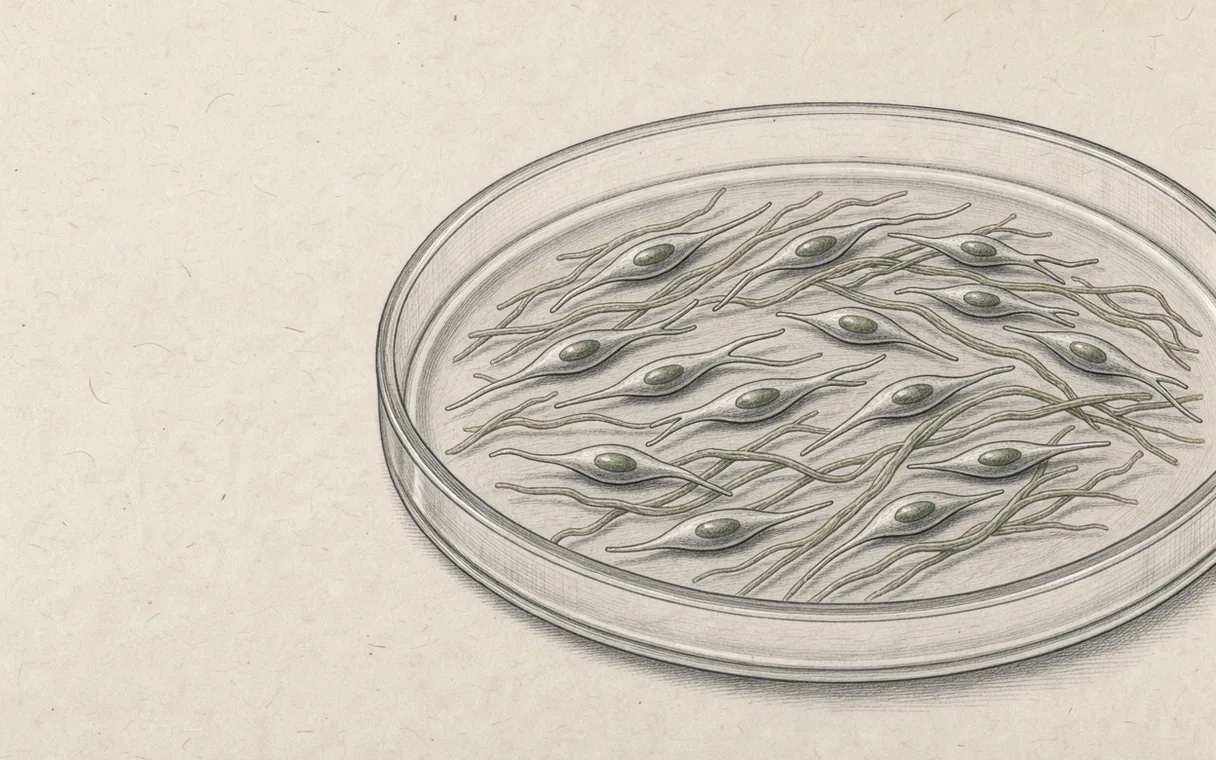
The 1988 fibroblast study gave GHK-Cu to human fibroblasts in a culture medium and found increased collagen synthesis. Fibroblasts are the cells doing the collagen-making work in this experiment. The stimulation occurred without altered cell numbers, which gives the result a pleasing specificity: the measured change was in their activity.
The tidy rejuvenation story I expected dissolves into something more precise here. This paper offers a bounded observation about collagen production in cultured cells. I trust that narrower description more. It gives the experiment room to be interesting on its own terms, without asking it to stand in for a visible change in somebody's skin.
The practical distance between those settings leads directly to skin delivery. A compound added to a culture medium has reached its experimental target. A topical preparation has another task in front of it.
The topical comparison
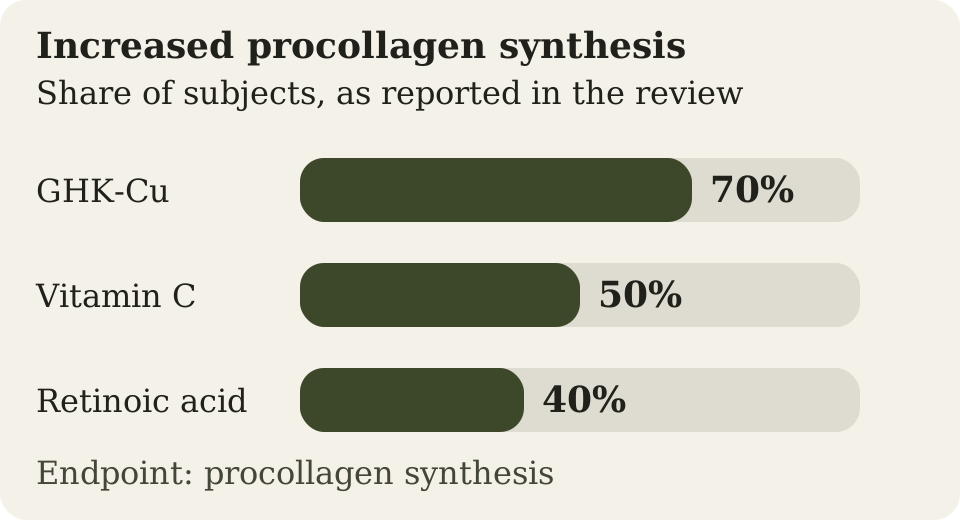
The 2025 review of topical GHK reports increased procollagen synthesis in 70% of GHK-Cu-treated subjects, compared with 50% for vitamin C and 40% for retinoic acid. Procollagen is the precursor material being measured in this account. These percentages describe the share of subjects showing an increase.
Every reproduction of the figures ought, in my opinion, to carry that last phrase. A reader could easily imagine a percentage change in wrinkle depth instead. The reported endpoint here is increased procollagen synthesis; a ranking of complete skincare approaches would require a much broader comparison.
The earlier skin-regeneration review also describes improvements in cosmetic outcomes including laxity, clarity, fine lines, wrinkle depth and density. That makes the human topical literature worth considering. My hesitation starts when a memorable percentage has to do more work than the endpoint allows.
Tissue remodelling
The tissue-remodelling review describes increased synthesis of collagen and elastin alongside metalloproteinases and anti-proteases. Metalloproteinases participate in matrix turnover; anti-proteases restrain protein breakdown. The unphotogenic vocabulary is where my curiosity really gets going.
I picture maintenance: production and turnover considered together. That is an interpretation of this mechanistic work. I want that picture tested against a particular tissue, preparation and visible outcome.
The review brings together human and animal work across different routes. A broad review can show how the pieces might connect; each particular cosmetic claim still needs its own result. For the obstacle between a topical preparation and those cells, continue to the skin barrier.